


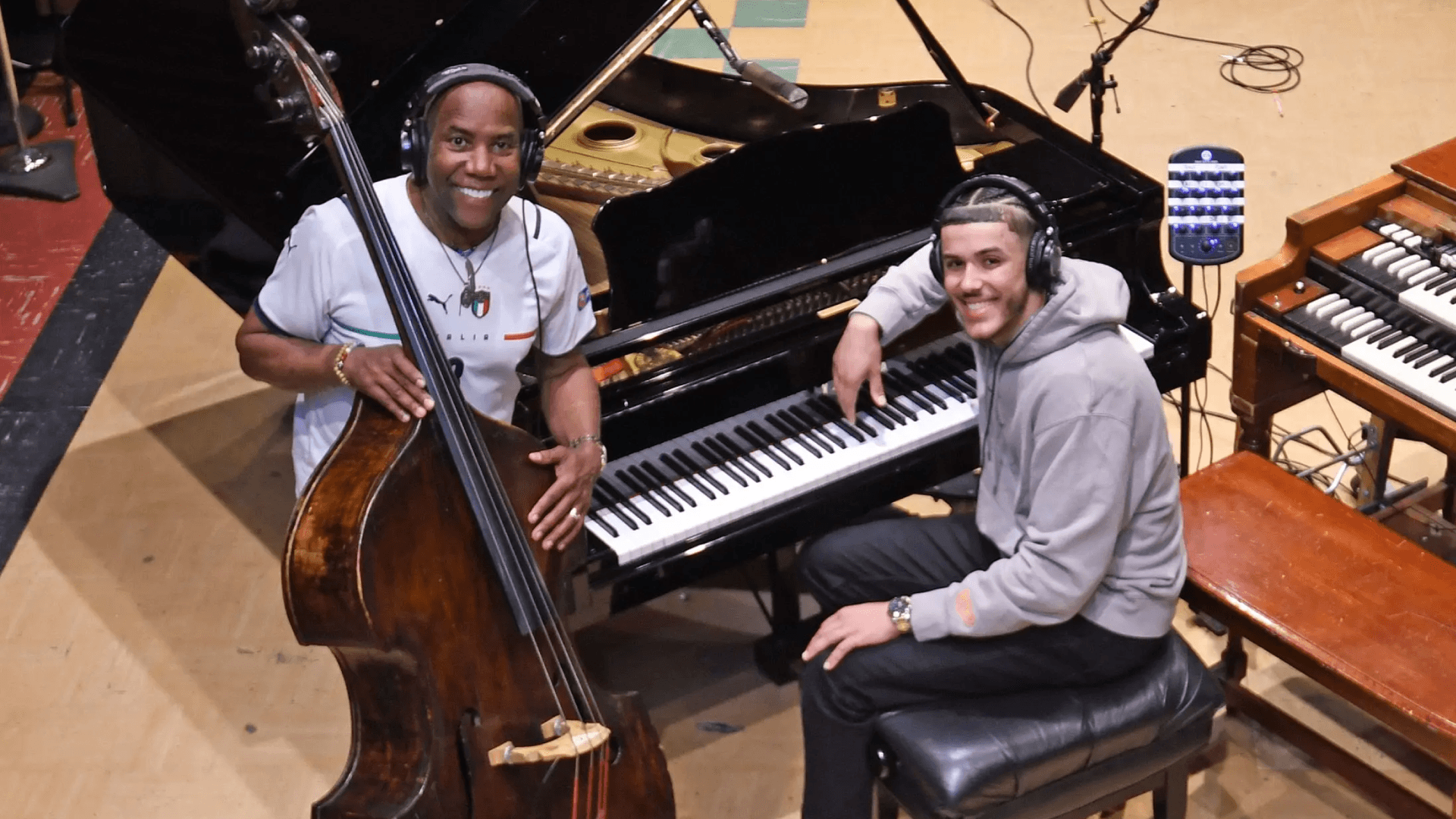
From Michael Jackson to Daft Punk | Nathan East — The Bass Legend Who Shaped Half a Century of Pop Music
2025.11.15
Music
Music
Even if the name Nathan East sounds unfamiliar, his basslines have already become the shared memory of an era. From Michael Jackson’s "Bad" and Eric Clapton’s "Tears in Heaven" to Daft Punk’s "Get Lucky," those moments when the world moved to the rhythm were anchored by his warm yet rock-steady low end.
For over forty years, the notes under Nathan’s fingertips have graced every golden age of popular music. Crossing genres—Jazz, Soul, R&B, Rock, and Pop—he has appeared on over 2,500 albums. His collaborators list is an endless roll call of legends: from Eric Clapton and rock titan Phil Collins, to R&B diva Whitney Houston and jazz master Herbie Hancock. You can even hear his bass on recordings by The Beatles' George Harrison, folk poet Bob Dylan, and superstar Beyoncé.
Without him, the landscape of popular music history would surely be unrecognizable.
Born in San Diego, California, Nathan’s first musical exposure was in the Black church choir. Initially a cello player, he switched to the bass. By high school, playing local live houses, he had already established a maturity beyond his years—no flashy solos, no spotlight-seeking, just a singular focus on making the entire band sound better.
His entry into the professional music world began after studying music at UC San Diego. Soon after, he was invited to work with R&B pioneer Barry White and film theme king Kenny Loggins. Through Quincy Jones’s introduction, his session career soared. Eventually, he joined Eric Clapton’s band, becoming a touring and recording partner for over three decades—an honor that, for any bassist, is akin to being knighted.
In an interview, he once smiled and said he simply "likes the music to sound right." This seemingly ordinary statement perfectly encapsulates the philosophy of his entire professional career.
Perhaps the most fitting description of his working style is "the music industry's most solid backbone." He is not a virtuosic showman seeking the spotlight; his goal is to let the music breathe freely.
On Eric Clapton's tours, he is always the man standing stage-left, smiling and nodding. Clapton once publicly stated, "Nathan is one of the musicians I trust most. As long as he's there, the entire groove is steady."
In the studio with Michael Jackson, he constructed the most fluid groove with minimal notes; in Whitney Houston’s ballads, he made the bass "speak" rather than "shout." This sense of restraint and exquisite balance is something only a true musician can achieve.
In Daft Punk’s 2013 hit "Get Lucky," a few clean takes reawakened the soul of '70s disco, creating a global dance floor classic. Even after the song won the Grammy for Record of the Year, he simply stated, "Being part of a record like that is my good luck."
Genuine, sincere, and substance over flash—that is the Nathan East style.
Many assume the bass is merely a rhythmic support, but he makes it "tell a story." There is always breathing room between his notes, allowing melody and rhythm to coexist. In the deepest part of a song, he lets you hear the pulse of the soul.
Compared to show-stopping bassists like Jaco Pastorius, Victor Wooten, and Marcus Miller, Nathan’s playing is more introspective. He believes music is about connection, not competition. Every slide, every accent, functions as the perfect rhythmic punctuation.
"My job is to make the singer feel comfortable." This sounds common, but it is the highest dictum for a session musician.
His tone is clean, thick, and soft—like a blanket for the melody to lean on. Whether it's blues, gospel, or pop, he finds the frequency that best complements others within any groove.
In 1991, he co-founded the super-jazz group Fourplay with pianist Bob James, guitarist Lee Ritenour, and drummer Harvey Mason. This collective redefined smooth jazz, blending jazz sophistication, R&B groove, and pop melody.
In Fourplay’s work, he was no longer a sideman but became one of the band's souls. His bass arrangements were freer and more expressive, and he even began to sing—a gentle, mature voice as steady and composed as his bass tone.
Fourplay's success showcased Nathan East's multifaceted persona. Whether in the studio or live, he maintained a sense of concise power amid complex harmonies and rhythms. This "precision in minimalism" became his signature.
The industry's praise for him is nearly unanimous. He is consistently described as smiling, punctual, professional, and without ego. Many say his groove is not just a technical display but an extension of his gentle character.
In a music world often driven by ego, Nathan has used humility and stability to prove that true power does not need to shout. He often speaks of his faith and family in interviews—for him, music is not just a career, but a way to share love and peace.
No matter how many superstars he has worked with, he maintains the same enthusiasm he had when first walking into a recording studio. This, indeed, is the mark of a true master.
If you are fortunate enough to see his live performance, you will notice a unique rapport between him and the stage. He never deliberately shows off; every pluck is as precise as a metronome, the rhythm steady yet full of breath. He occasionally looks up at his bandmates, a slight upturn of his lips, and the entire band instantly relaxes.
It is an aura of leadership without pressure, and precision without rigidity. When he picks up his bass on a stage like Billboard Live, it is not just a performance; it feels like a homecoming trip. With a simple raise of his hand, the entire room's rhythm starts to breathe with him.
He brings more than just notes. He brings a memory of popular music—a philosophy of "making the world sound better."
In this fast-food age, there is too much sonic flash and too little quiet groove. Nathan East’s existence reminds us that the essence of music is not performance, but connection. That line connecting the audience, the melody, the emotion, and the soul is his low end.
From Stevie Wonder to Daft Punk, his presence spans half a century of popular music.
As the lights dim and the low end begins to play, you might suddenly realize—this sound has been with you for half your life.
Date: Nov 20, 2025
Price: NTD 1,600–14,000